

Conscience is a Window to Truth
More on Pope Benedict's work and its reception by Gen Z


After I had a positive response from my Gen Z students to the Pope Benedict VXI essay Conscience and Truth, I decided to leave a copy on my kitchen counter with my twenty-year-old son’s name on it. Maybe he’d pick it up and read it, I thought. The parents among you will understand my reasoning… if I gave it to him and told him to read it, he would definitely not read it. Or, he would read it like it was an obligation. I wanted to find out if he liked it as much as the other students who’d read it.
A few days later, and to my surprise, he said “Oh yeah, I read that thing.”
“What thing?” I asked. I forgot I left the essay on the counter.
“That thing. The one by, you know, that one Pope. It was pretty cool. He talked about Nazis.”
“He did,” I said, “He talked about Nazis. Remember what he said?”
“Yeah.”
Then, my son and I discussed the topic of the essay, which is about the reality of goodness, and the human ability to know it, or to ignore it. I thanked God for this discussion, and I will remember it as long as I have memory.
Before I get into the essay, though, I do want to address some of the comments I’ve received. I know that Benedict was a controversial Pope. I have read a lot and have studied philosophy and theology my entire life. I read The New Testament and was converted by it when I was eleven (it was the King James Version, at the time I didn’t know there were so many translations). I have also read the works of Friedrich Nietzsche, Martin Heidegger, Arthur C. Clarke, and many authors whom I have never met and whose character I cannot vouch for (and who I probably would not want to meet). I’ve learned a lot from them—good things and troubling things. I do know that the essay, Conscience and Truth, is amazing, and the Pope’s theological insight profound. That is why I shared it with my students, my kids, and why I write about it here.
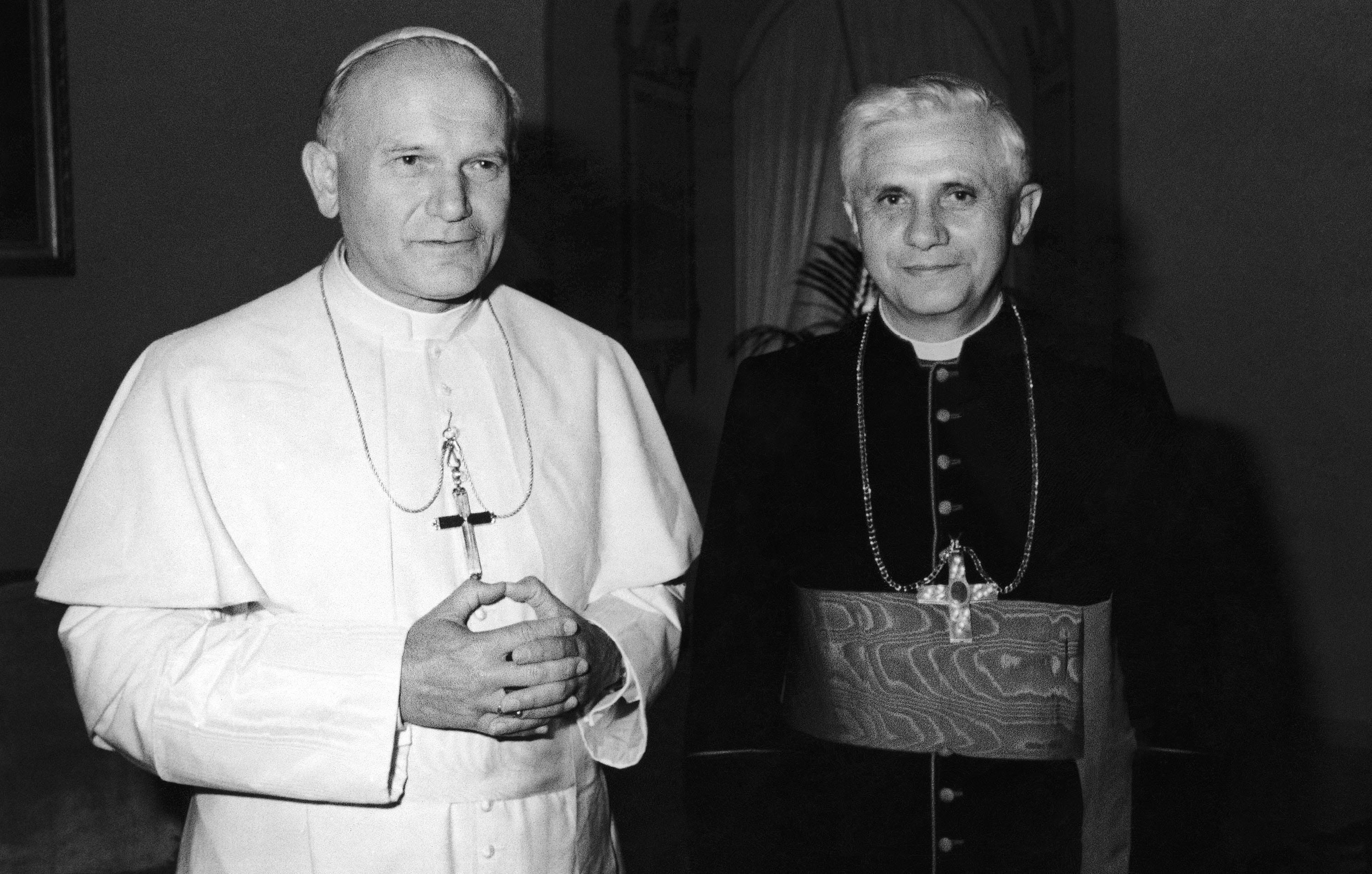
Pope Benedict XVI wrote this essay when he was Cardinal Joseph Ratzinger. It appears to have been presented to Bishops in 1991 before he wrote it down, and it does have the flavor of a serious yet friendly discussion. He starts with an anecdote from his time in seminary when young priests-in-formation jostle with each other over theological interpretations of scripture. At the time, many young Catholics, including students in Ratzinger’s cohort, felt that conscience—an internal feedback system that helps one judge right from wrong, was the most direct and ultimate criteria for actions in the world. It was thought that if a person followed their conscience, then this would exonerate them from any negative judgement as they had aligned their action with their inner conviction.
Going deeper into the anecdote, Ratzinger registers his intuition that there is something very wrong with this position. It is not until one of his peers exclaims that even Nazis would be exonerated from any negative judgement as they had followed their conscience faithfully, even though it was clearly wrong. At this point Benedict sees that he must urgently correct this argument. This, then, was the motivation for the essay. He needed to correct the understanding of conscience as a form of subjectivism and relativism, and to reveal that the roots of conscience lie in the objective truth of goodness. Thus, he goes back to Socrates.
Benedict calls Socrates a pre-Christian guide to conscience. He references Socrates’s (through his student Plato) arguments with the Sophists of Athens. As I tell my own students, yes, this ancient argument is relevant today. Ratzinger writes:
“At this point, the whole radicality of today’s dispute over ethics and conscience, its center, becomes plain. It seems to me that the parallel in the history of thought is the quarrel between Socrates-Plato and the sophists in which the fateful decision between two fundamental positions has been rehearsed. There is, on the one hand, the position of confidence in man’s capacity for truth. On the other, there is a worldview in which man alone sets standards for himself. The fact that Socrates, the pagan, could become in a certain respect the prophet of Jesus Christ has its roots in this fundamental question. Socrates’ taking up of this question bestowed on the way of philosophizing inspired by him a kind of salvation- historical privilege and made it an appropriate vessel for the Christian Logos. For with the Christian Logos we are dealing with liberation through truth and to truth. If you isolate Socrates’ dispute from the accidents of the time and take into account his use of other arguments and terminology, you begin to see how closely this is the same dilemma we face today.” (from Conscience and Truth).
Ratzinger shows how Socrates’s assessment of the mistake of the Sophists is the very mistake his peers have made in the 1990s. The question is between pure subjectivity (nothing but us, folks) and objective truth (there is something out there). He points to the Apostle Paul in the first century who recovers “anamnesis” – Socrates’s knowledge as recollection, and reveals its place in Christian history. Instead of being a private, self-enclosed space, Ratzinger describes conscience as a window, an opening through which the human person encounters a truth that is not self-generated. Conscience is a “window through which one can see outward to that common truth which founds and sustains us all, and so makes possible through the common recognition of truth, the community of needs and responsibilities.” It thus establishes one’s obligations and duties. This is what seemed very surprising to my Gen Z students. They had not thought of conscience in this way before. It could be the case that they had not thought of conscience at all…
When that window closes, when conscience becomes merely a “protective shell,” the person is not liberated but trapped. What feels like freedom becomes conformity—either to one’s own impulses or to the surrounding culture. This is one of the sharpest insights of the essay: that a purely subjective conscience does not resist authority; it actually becomes more vulnerable to it, because it loses contact with any standard beyond itself.
Ratzinger taps into the tradition that holds that conscience is not something we invent; it is something we discover. He retrieves Socratic anamnesis—that there is in the human being a memory of the good and an orientation toward truth that precedes conscious reasoning. We recognize truth, he suggests, not because we create it, but because something in us resonates with it. This is why conscience can accuse us, disturb us, even wound us. Ratzinger says that the feeling of guilt is not a defect but a sign of health—the signal that we are still in contact with reality. When that signal disappears, when a person no longer feels guilt, this is not moral maturity but a kind of spiritual deadness.
This portion of Ratzinger’s essay reminds me of the work of philosopher Hannah Arendt, especially her book The Life of the Mind. Arendt was Jewish and had escaped Nazi occupied France in 1940 and eventually became a professor of philosophy in the United States. In The Life of the Mind, published posthumously (she was working on it when she died), her central question is: why do some people choose to do evil? One of the answers (there are a few) she arrives at is based on her observation that good people have regrets. Evil people do not. “The most dangerous people are not those who choose evil with anguish, but those who do not think, and therefore are not disturbed by what they do.” Evil people sleep well at night, she writes, and they do not have what good people have, which is an inner conversation about their actions in the world.

Guilt, or, having a guilty conscience, is a step toward the recognition of, and what Ratzinger calls us to see—the reality of goodness. Goodness calls us to align ourselves with it. Arendt was steeped in the atheistic intellectualism of this era of German philosophy, but her framework of the inner conversation of the good person always rang, well, true to me.
I’ll say more in a later post here, as a there is more to say about this essay. Again, it was a surprise to learn that my students enjoyed these essays and that they wanted to learn more about conscience. They were also eager to learn more about how social media technologies can alter these areas of the brain that are engaged in making ethical and altruistic decisions. Again… more to come about that, too.
Great subject!
Have you read CS Lewis on this in his Mere Christianity?
I asked Grok to summarize for me…
In Mere Christianity, C.S. Lewis opens Book 1 ("Right and Wrong as a Clue to the Meaning of the Universe") by arguing that humans share a universal Moral Law (also called the Law of Human Nature, the Law of Right and Wrong, or the Rule of Decent Behaviour). This internal sense of what one "ought" to do—often experienced as conscience—serves as a key clue pointing toward God's existence. Lewis presents it not as a mere feeling, instinct, or social invention, but as an objective reality that judges our behavior and reveals something transcendent behind the universe.
In reflection, during the 90's I was only marginally aware of Pope Benedict. Oddly enough I had, somehow been more aware of the Cardinal Ratzinger. During those times I was, what one colleague called it "At war with Catholicism". Even today I have been referred to as "Post Christian". I do not disagree. And now with the advent of today's new thinkers, and researchers, more information mostly uncovered by, in articular, this case, You Diana.I have downloaded the PDF file of Conscience and Truth, and will begin its study. As an etymology student, I am compelled to examine many words, carefully. The word Conscience, is derived from Latin and points to "a joint knowledge of something, a knowing of a thing together with another person; consciousness, knowledge". Particularly within one's self, a sense of right and wrong". Truth it's root begins with True, and as a stonemasons term points to reliable. It's merely a start, but I'll be digging. I appreciate what you bring to us here, and elswhere.